
RT-0003
Daitrabeer Baba Mandir, Luxa: A Guardian Under the Banyan
At Ramkund in Luxa, Varanasi, a small red temple under a banyan and a neem houses Daitrabeer Baba, a guardian deity the neighbourhood trusts to keep harm away.
 Field notes by Sreya Das
Arya Mahila PG College, Varanasi · Visited 10 November 2025
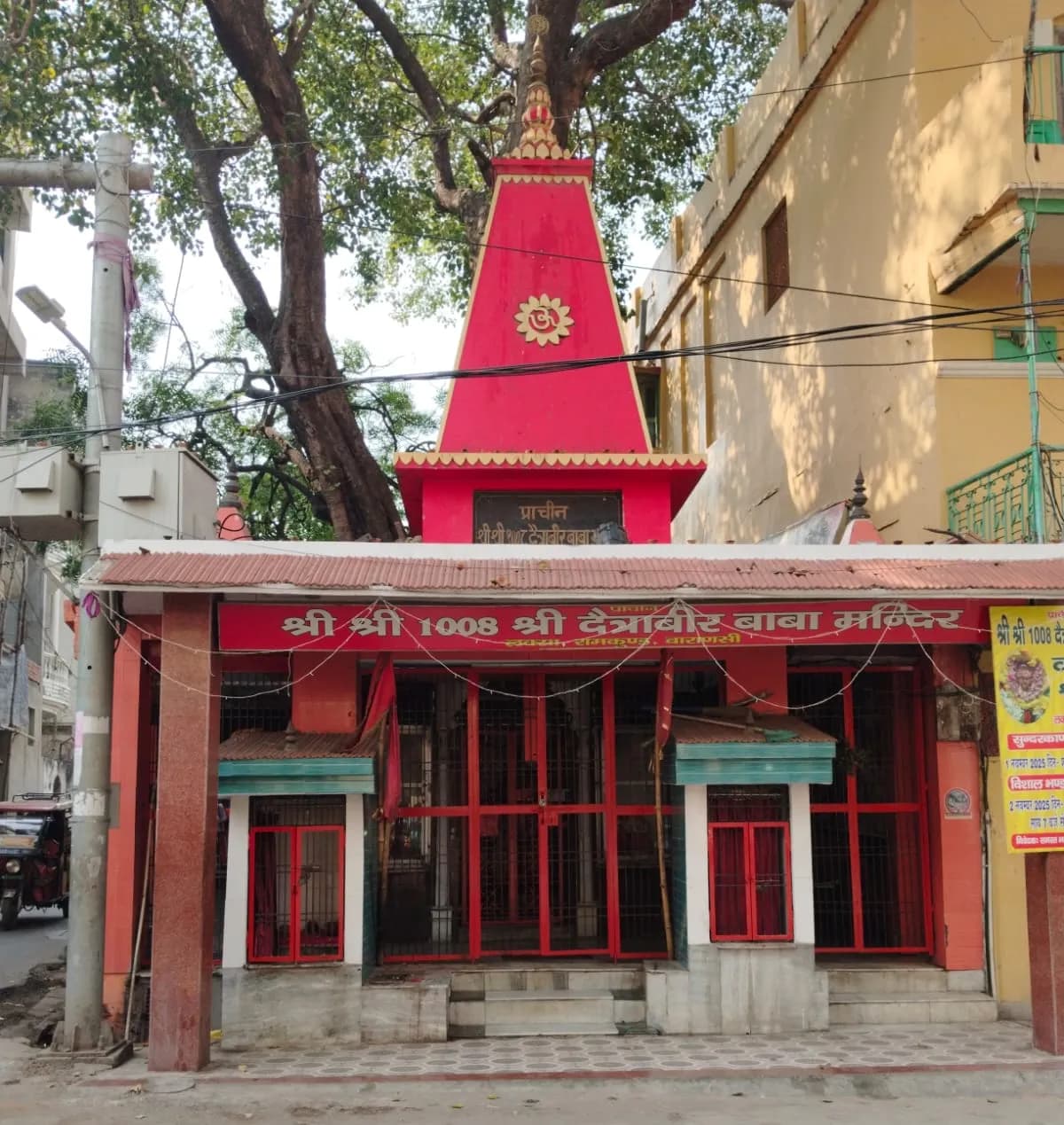
On the signboard: श्री श्री 1008 श्री देत्राबीर बाबा मन्दिर
Daitrabeer Baba Mandir is a small red temple at Ramkund in the Luxa area of Varanasi. It belongs to a Bir Baba, one of the guardian deities that the neighbourhoods of Banaras keep close to their roads and lanes. Sreya Das visited on 10 November 2025.
Finding it
The temple stands at the roadside where a market road opens into quieter residential lanes. An old banyan and a neem grow behind it, and their branches cover most of the roof. The board over the entrance reads "Shri Shri 1008 Shri Daitrabeer Baba Mandir" in Hindi. A plaque above the board carries the word prachin, which means old.
What you see
The building is brick, painted red with touches of gold, and the floor is marble. A tall red spire rises from the roof with a gold emblem on its face. Red steel grilles close the front, and two small niches with green canopies sit on either side of the steps.
Inside is a small square sanctum. The image of Baba is brass and no more than two feet high. He is dressed in red cloth, hung with garlands and marked with vermilion. A few iron bells hang near the doorway, and Sreya notes how soft they sound when someone rings one after a prayer.
How it is worshipped
A priest comes every morning for nitya puja, the daily worship, and returns in the evening for sandhya aarti, the lamp offering at dusk. He bathes the image, changes its clothes and sets out fresh flowers and fruit. Neighbours gather at these hours with flowers and lamps of their own.
For the rest of the day the temple is a stop on the way to somewhere else. People walking past pause, fold their hands, bow, and carry on.
What people say
People here speak of Baba as someone who sits in his place and watches over the area, closer to a neighbour than to a distant god. The stories about him differ from one teller to the next, and Sreya did not hear a single agreed version. What every account shares is the belief that his blessing keeps harm and accident away from the neighbourhood.
Nothing about the temple's history is written down. Sreya records its age as about fifty years. The plaque calls it old, so the site may have been a place of worship before the present building went up. We have found no record that settles the question and we leave it open.
The wider picture
From the Indic Warriors Editorial Desk.
Bir means brave. In Banaras a Bir Baba is a neighbourhood's own protector, and his place usually sits beside the road or the boundary he is believed to guard. The anthropologist Diane Coccari, who studied them, described the Bir Babas as the neighbourhood guardian deities of the city.
Many of these places are plain and open to the weather. This one has a spire, a marble floor and a priest who comes twice a day, which gives some idea of how much the people of Ramkund have put into it over the years.
Our explainer on the Bir Babas of Banaras goes further into who they are and how they are worshipped. This entry is part of Roadside Temples, a field series on Indic Warriors.
If you visit
On a Monday afternoon in November the grilles were shut. The priest is present in the morning and again in the evening. At other times you can stand at the steps as passers-by do. Leave your shoes below the platform.
- Source for the wider picture: Diane M. Coccari, "Protection and Identity: Banaras's Bir Babas as Neighborhood Guardian Deities", in Sandria B. Freitag (ed.), Culture and Power in Banaras (University of California Press, 1989).
Field notes by Sreya Das · Edited and expanded by the Indic Warriors Editorial Desk · Published by Indic Warriors