
Sarnath and the Buddhist Layer of Kashi
Ten kilometres from the ghats is the field where the Buddha first taught and where India found its state emblem, and reading it properly changes what Kashi is a city of.
Indic Warriors Editorial · 28 November 2026 · 5 min read
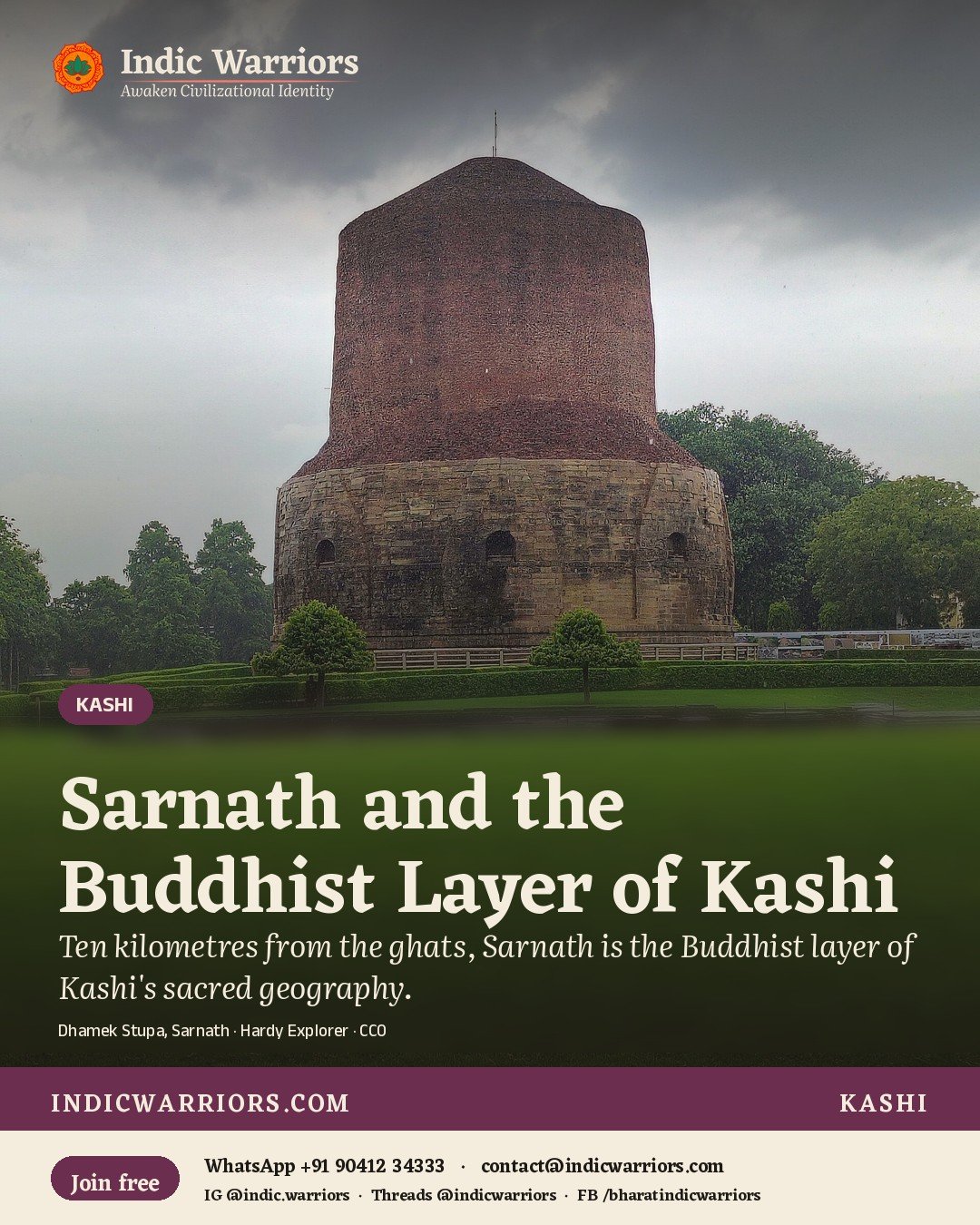
Kashi is described, almost everywhere, as the city of Shiva. That is true, and it is not the whole truth. Ten kilometres from the ghats stands the place where the Buddha gave his first sermon, and a few kilometres from that is a site the Jaina tradition holds as the birthplace of one of its tirthankaras. The sacred geography of Kashi has layers, and a visitor who sees only one of them is looking at a city with one eye closed.
Our heritage-walk album has photographed this ground. This piece explains it.
What happened at Sarnath
The Buddha attained enlightenment at Bodh Gaya, in what is now Bihar. He did not begin teaching there. He walked to the deer park outside Kashi, and it was here, to a small group of his former companions, that he gave the discourse the tradition calls the setting in motion of the wheel of dharma. Everything institutional about Buddhism, the entire order of monks and the teaching lineage that eventually reached Sri Lanka, Tibet, China and Japan, begins in that conversation.
The choice of location was not accidental. Kashi was already an old centre of learning and argument, a place where a teacher with a new position went to be heard and contested. The Buddha went to the intellectual capital.
Reading the site
Sarnath is unusually legible for a ruin, because its main structures each belong to a different phase and can be told apart.
- The great brick stupa that dominates the site marks the sermon’s location. Its scale is the point: a mound of that size represents institutional wealth and royal patronage over centuries, not a single act of piety.
- The Ashokan pillar, of which the shaft survives in fragments, was erected by the emperor Ashoka in the third century BCE when he visited. Its capital, four lions seated back to back above a wheel, is in the site museum — and it is the object every Indian has seen a thousand times without visiting, because it is the State Emblem of India, and the wheel beneath it is the wheel on the national flag. The republic took its insignia from this field.
- The second stupa, at the edge of the site, carries a later octagonal tower built on top of it in the Mughal period to mark a royal visit. It is worth standing in front of, because it is a single structure recording two religions and about a thousand years, one sitting literally on the other.
- The monastic foundations laid out around the stupa are the residential and teaching quarters. They are what turn a pilgrimage spot into a university, and their extent tells you how many people lived and studied here.
The part the guidebooks skip: it was lost
Sarnath was not continuously venerated. Buddhist institutional life in the region declined over centuries, for reasons that are still argued about among historians and are not reducible to any single cause. The site was abandoned, its brick was quarried for construction elsewhere, and by the early modern period it was a mound in a field.
What stands there now is the result of excavation, conservation and deliberate revival. The Mahabodhi Society built a functioning temple beside the ruins in the 1930s. A central institute of Tibetan studies was established at Sarnath in the twentieth century and remains a serious centre of scholarship. Sri Lankan, Thai, Japanese, Tibetan, Burmese and Chinese communities have each built a temple in their own architectural idiom, which makes the modern approach road an accidental museum of Buddhist Asia.
That sequence, from centre to ruin to reconstructed centre, is the most instructive thing about the place. Continuity is not automatic. Somebody has to want it, and here the wanting came largely from outside India before it came from within.
The Jaina layer, briefly
A short distance from Sarnath is a site the Jaina tradition identifies as the birthplace of Shreyansanath, one of the twenty-four tirthankaras, with a temple maintained there. Kashi also figures in Jaina accounts as a place of teaching. This is a smaller layer than the Buddhist one but it is the same lesson: the region’s sacred geography was contested and shared by several traditions at once, over a very long period.
Held together, not flattened
Two ways of handling this history are both wrong. One is to present Kashi as a purely Shaiva city and treat Sarnath as an unrelated Buddhist tourist site ten kilometres away, which is how most itineraries are actually built. The other is to present the layers as a harmony, a tidy story of pluralism in which nobody ever argued.
Neither survives contact with the sources. What the record shows is genuine and often sharp argument between traditions that nonetheless shared a landscape, patronage networks, vocabulary and pilgrims — and periods of decline and revival for each of them at different times. That is a more interesting city than either simplification, and a more honest one.
Seeing it properly
Sarnath deserves half a day, not the ninety minutes most Kashi itineraries allow. Take the museum first, so that the lion capital is in your head before you walk the field. Then the monastic foundations before the stupa, because the plan of the living quarters is what makes the scale of the stupa mean something. Sit in the deer park at the end.
Our photographic record of this ground is in the Sarnath and Ramnagar heritage walk album, and the ghats that anchor the other half of the city are in our first ghats album. For the architectural vocabulary underneath all of it, see our Kashi temple architecture mapping.
Everything we publish on the city collects on the Kashi and Living Heritage shelf, which now carries a curated Start-here path for readers arriving cold.
Credits
Written by the Indic Warriors Editorial team from the standard published record of the site and its excavation history, and from our own fieldwork in Sarnath and Kashi. Where historians disagree — particularly on the causes and pace of Buddhist institutional decline in the region — this piece says so rather than choosing a side. Corrections from archaeologists, monastic communities and local historians are welcome and will be credited in revisions.
Written by Indic Warriors Editorial · Published by Indic Warriors · 28 November 2026
More in Journal & E-Magazine
Kashi & Living Heritage
Sarnath and the Buddhist Layer of Kashi
Ten kilometres from the ghats is the field where the Buddha first taught and where India found its state emblem, and reading it properly changes what Kashi is a city of.
Indic Warriors Editorial · 28 November 2026 · 5 min read
Education & ParentingScholars
The Samskara Year: A Family’s Month-by-Month Guide
The rites follow a life rather than a calendar, which is why families lose them; this guide pairs the sequence of samskaras with a twelve-month household plan that makes keeping them a matter of preparation instead of memory.
Indic Warriors Editorial · 25 November 2026 · 7 min read
Temple, Art & HeritageMembers
Temple Iconography: A Field Key to the Deities
The sculptor was working to a specification, and the specification is readable: a usable field key that identifies most temple images in under a minute, starting with what the figure holds rather than how its face looks.
Indic Warriors Editorial · 23 November 2026 · 5 min read
Dharma & PhilosophyMembers
A Reader’s Map to the Six Darshanas
Six schools, three pairs, one thread: a working map of Indian philosophy that tells you what each darshana owns, what it argues against, and the order in which to meet them.
Indic Warriors Editorial · 21 November 2026 · 5 min read