
Dinacharya: The Day as Medicine
Ayurveda’s first prescription is not a remedy but a routine, and the daily regimen makes sense the moment you see the single idea holding all of it together.
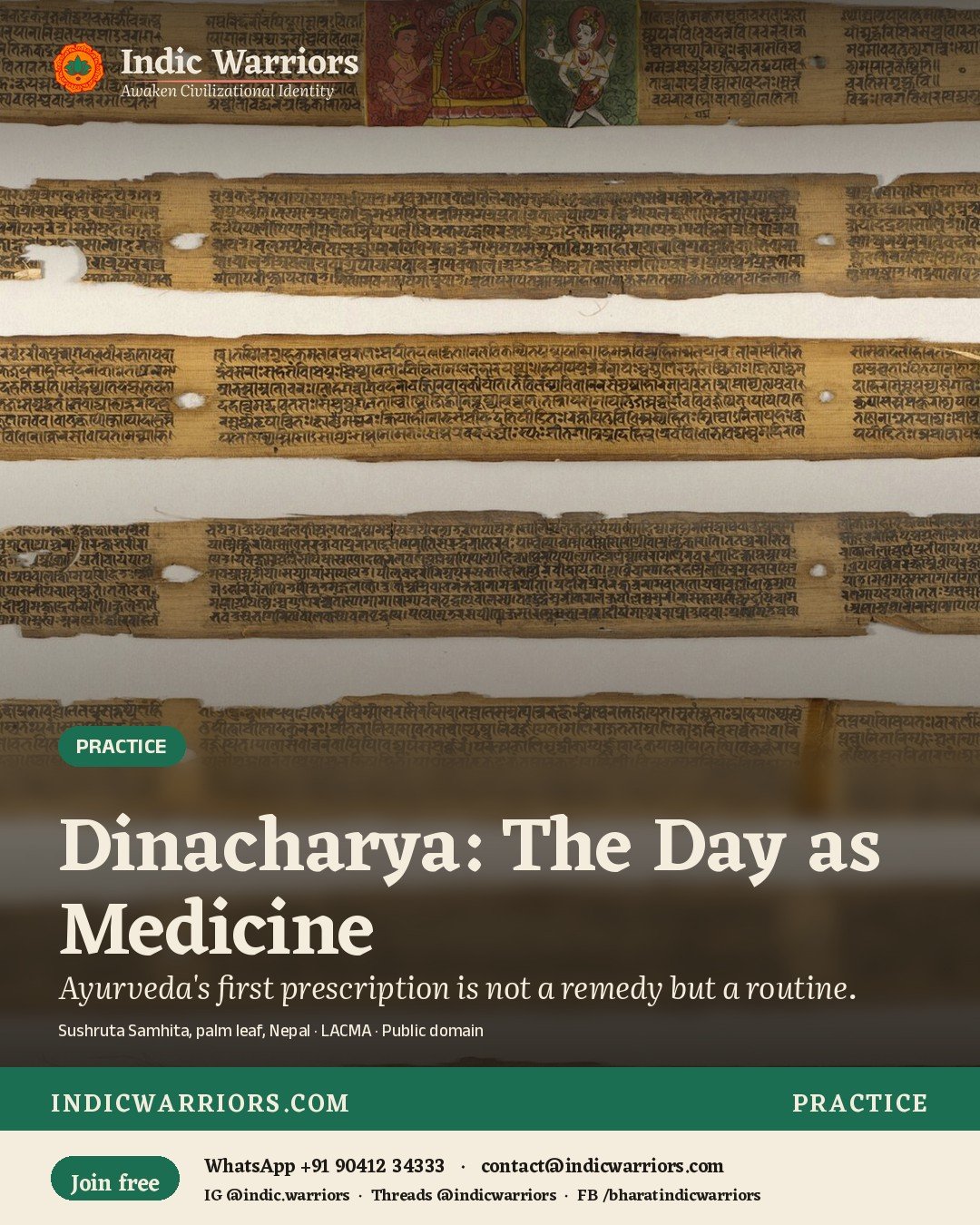
Ayurveda is popularly known in the form it travels worst: as a shelf of remedies. Oils, powders, a herb for this and a decoction for that. What that presentation loses is the part the classical literature considers primary, which is not the remedy at all. It is the day.
Dinacharya means the conduct of the day, and the tradition treats it as the first line of medicine rather than the soft advice given after the real prescription. This is the opening piece on our Ayurveda and Wellbeing shelf, and it starts with the regimen because everything else on the shelf assumes it.
The premise: regularity is itself therapeutic
The classical position is that a body is not a closed machine but something in continuous exchange with its surroundings: with light, temperature, season, food, activity and sleep. Because the surroundings move in cycles, the body’s functions are expected to move with them. Health, in this account, is largely what happens when that alignment is maintained. Disease begins, long before symptoms, as a persistent misalignment.
This is why the tradition’s advice sounds unglamorous. It is not trying to correct an event. It is trying to prevent the accumulation of small daily errors, which is a different and slower kind of medicine.
The day has a structure
The tradition divides the day and night into segments, each associated with the dominance of one of the three functional principles that Ayurveda uses to describe physiology. The details of that scheme are a subject in themselves, but the practical consequence is easy to state: the same act has different effects at different hours. A heavy meal at midday and the identical meal at midnight are not the same input. Waking at first light and waking three hours later are not the same waking.
Almost the whole of dinacharya follows from taking that seriously.
The regimen, in order
- Waking before sunrise. The pre-dawn interval is singled out in the literature as the period of greatest clarity, and it is the hinge of the whole routine: nothing else in the day can be regular if this is not.
- Elimination first. The body’s own clearing is expected before anything is put into it. A regimen that ignores this and begins with food is working against the sequence.
- Care of the mouth and nose. Cleaning the tongue, rinsing and holding warm liquid in the mouth, and attention to the nasal passages. These are treated as daily hygiene of the passages through which the body meets the world, not as occasional treatments.
- Oil applied to the body. Abhyanga, the self-application of oil before bathing, is among the most emphasised of the daily practices. It is prescribed for the joints, the skin, the nerves and the settling of the mind, and it is the practice most often abandoned first for lack of time.
- Movement, then bathing. Exertion to the point of effort but not exhaustion, followed by a bath, which the tradition treats as restorative rather than merely cleansing.
- The main meal at midday. Digestive capacity is held to be at its strongest when the sun is highest, so the largest meal belongs there. The corollary is the one modern households find hardest: the evening meal should be the light one, and early.
- Sleep at a fixed and early hour. Sleep is classed among the pillars that sustain the body, not among its luxuries, and irregular sleep is treated as a cause of disorder rather than a symptom of a busy life.
The concept doing the work: agni
Underneath every one of those instructions sits a single idea. Agni is the term for the body’s digestive and transformative capacity, and in this system it is the central variable of health. Food is not nourishing because of what it contains but because of what the body can transform it into. Strong and regular agni turns food into tissue; weak or erratic agni leaves behind an unassimilated residue, and the accumulation of that residue is the tradition’s general model of how illness starts.
Read the regimen again with that in mind and it stops looking like a list of pious habits. Eating the main meal at midday, keeping the evening meal light, not grazing between meals, not sleeping immediately after eating: every item is a rule about protecting a transformative capacity from being overwhelmed.
The year, not just the day
Dinacharya has a seasonal counterpart. Ritucharya adjusts the same regimen across the year: what is appropriate food, exertion and covering in one season is inappropriate in another, and the transitions between seasons are singled out as the periods when people fall ill. Following it requires knowing where in the traditional year you actually are, which is what the almanac is for. Our piece on how the panchanga reckons time covers that reckoning.
What to actually do tomorrow
Attempting the entire regimen at once is the standard way to abandon it within a fortnight. The tradition’s own logic argues for the opposite approach, since the benefit is claimed for consistency rather than for intensity. Two changes are enough to begin with: a fixed waking hour, and moving the day’s largest meal to midday. Both are free, both are measurable within a couple of weeks, and both are the prerequisites for everything else in the list.
Read alongside our piece on what the Yoga Sutras actually teach, which describes the same insistence on regulated daily practice from the side of the mind rather than the body.
Everything on this subject will be gathered on the Ayurveda and Wellbeing shelf as it grows.
Credits
Written by the Indic Warriors Editorial team, drawing on the daily and seasonal regimen as set out in the classical Ayurvedic compendia and as taught in the tradition generally; no individual practitioner’s protocol or course material is reproduced. This piece is a description of a classical regimen and is not medical advice. Anyone with a diagnosed condition, or on medication, should consult a qualified physician before changing diet, sleep or exercise.
Discussion
Comments are public and carry your name. Your institution is never shown.
Looking for a mentor? Find verified Indic mentors by city. Exploring the institutions? See the colleges guide.