
The Panchanga: How Bharat Reads Time
The Indian almanac measures five independent astronomical quantities every day, and understanding those five limbs explains why a festival keeps moving against the wall calendar but never against the sky.
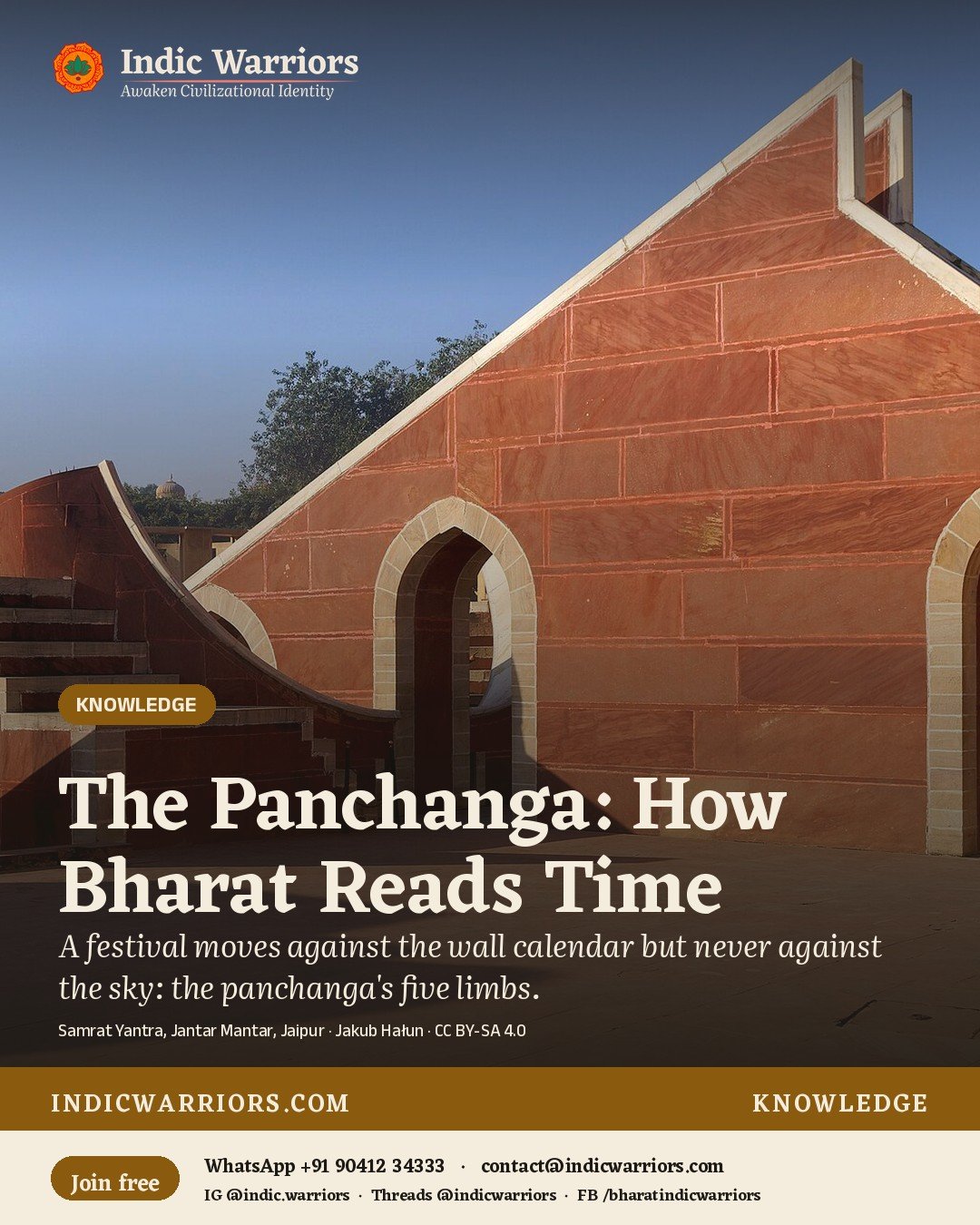
Every year, somebody in every Indian family asks the same question: why is the festival on a different date this time? The answer is not that the calendar is imprecise. It is that the calendar being consulted is not the one hanging on the wall. It is the panchanga, and it is measuring something the Gregorian calendar does not attempt to measure at all.
This is the first piece on our Jyotisha and Vastu shelf. Before anything else on this shelf can be discussed sensibly, the timekeeping has to be understood, because it is the substrate under almost every observance an Indian household keeps.
Five limbs, not one number
The word panchanga means “five limbs”, and that is exactly what it is: a daily reckoning of five independent quantities, each derived from the observed positions of the sun and the moon.
- Tithi — the lunar day, defined not by sunrise but by the angular distance the moon has gained on the sun. Because the moon does not travel at a uniform apparent speed, a tithi is not a fixed number of hours. It can be shorter or longer than a civil day, which is why a tithi sometimes skips a date or occupies two.
- Vara — the weekday, the one limb that behaves exactly as you expect, running in an unbroken seven-day cycle.
- Nakshatra — which of the divisions of the ecliptic the moon currently occupies. This is the moon’s address for the day.
- Yoga — a quantity computed from the combined positions of sun and moon, tracking their joint progress rather than their separation.
- Karana — half of a tithi, giving a finer subdivision for purposes that need one.
Read together, these five give a description of a day that is astronomical rather than administrative. The Gregorian date tells you where you are in a bookkeeping sequence. The panchanga tells you where the sky is.
Why the year is stitched from two clocks
The Indian calendrical tradition is luni-solar, and that hyphen carries all the complexity. Months are reckoned by the moon, because the moon is legible: anyone can look up and know roughly where in the month they are. But the agricultural and seasonal year is governed by the sun, and twelve lunar months fall short of a solar year by roughly eleven days.
Left uncorrected, that shortfall would walk the festivals backwards through the seasons within a generation, which is precisely what happens in a purely lunar calendar. The tradition’s solution is an intercalary month, inserted according to rule, which pulls the lunar count back into alignment with the solar year. The consequence is the one that puzzles families every year: an observance keeps its position against the moon and the season, and therefore moves against the Gregorian date. Nothing has drifted. A different thing is being held fixed.
The regional variants are features, not errors
Panchangas differ across regions, and the differences are principled. Some traditions begin the month at the new moon and others at the full moon, which shifts the naming of a fortnight without shifting the sky. New-year observances fall at different points because different traditions mark the year’s beginning from different events. A household following one reckoning and a neighbour following another are not disagreeing about astronomy; they are using different conventions built on the same observations.
This is worth saying plainly, because the diversity is often mistaken for confusion by people encountering it from outside. A calendar that survived across a subcontinent for millennia did so by being locally adaptable.
Muhurta, and what it is not
The most familiar practical use of a panchanga is the selection of a muhurta, an auspicious window for beginning something that matters: a marriage, a house-warming, a child’s first lessons. What is actually happening in that consultation is a reading of the five limbs for a proposed interval, judged against the accumulated rules of the tradition about which combinations suit which undertakings.
It is worth being careful about the claim being made here. This piece describes a timekeeping system and the internal logic by which it has been used for centuries. That is a matter of record. Whether the predictive weight the tradition places on particular combinations can be independently established is a separate question, and one we are not settling in a first piece on the shelf. What can be said without qualification is that the astronomy underneath is real astronomy, computed to a standard that made Indian calendrical work portable across the Indian Ocean world.
Reading your own panchanga
Any printed or digital panchanga will give you the five limbs for the day, along with sunrise, the ending times of the current tithi and nakshatra, and the intervals the local tradition marks as favourable or otherwise. The single most useful habit is to notice the ending times rather than only the labels: a tithi that ends mid-morning means the day’s character changes at mid-morning, and much of the apparent contradiction between two almanacs dissolves once you see which one is quoting the tithi at sunrise and which at the moment of consultation.
Time is one of the places where Indian and Western intellectual traditions diverge most sharply, and not only in the arithmetic. Our lecture on the Indian and Western concepts of time takes up that larger difference, and the two pieces are best read together.
Vastu, the other half of this shelf, gets its own treatment shortly. Everything published here will appear on the Jyotisha and Vastu shelf.
Credits
Written by the Indic Warriors Editorial team. This piece draws on the classical calendrical and astronomical literature of the Indian tradition and on the standard structure of the printed panchanga as it is published across regions today. It reproduces no individual teacher’s course material or interpretive framework. Readers who maintain a regional panchanga tradition we have described too briefly are invited to write in; corrections will be credited.
Discussion
Comments are public and carry your name. Your institution is never shown.
Looking for a mentor? Find verified Indic mentors by city. Exploring the institutions? See the colleges guide.