
Thinking With Chanakya: Niti as a Method
The Indian tradition built a whole genre for practical judgment, and reading it properly is nothing like the airport-bookshop Chanakya who promises the secrets of success.
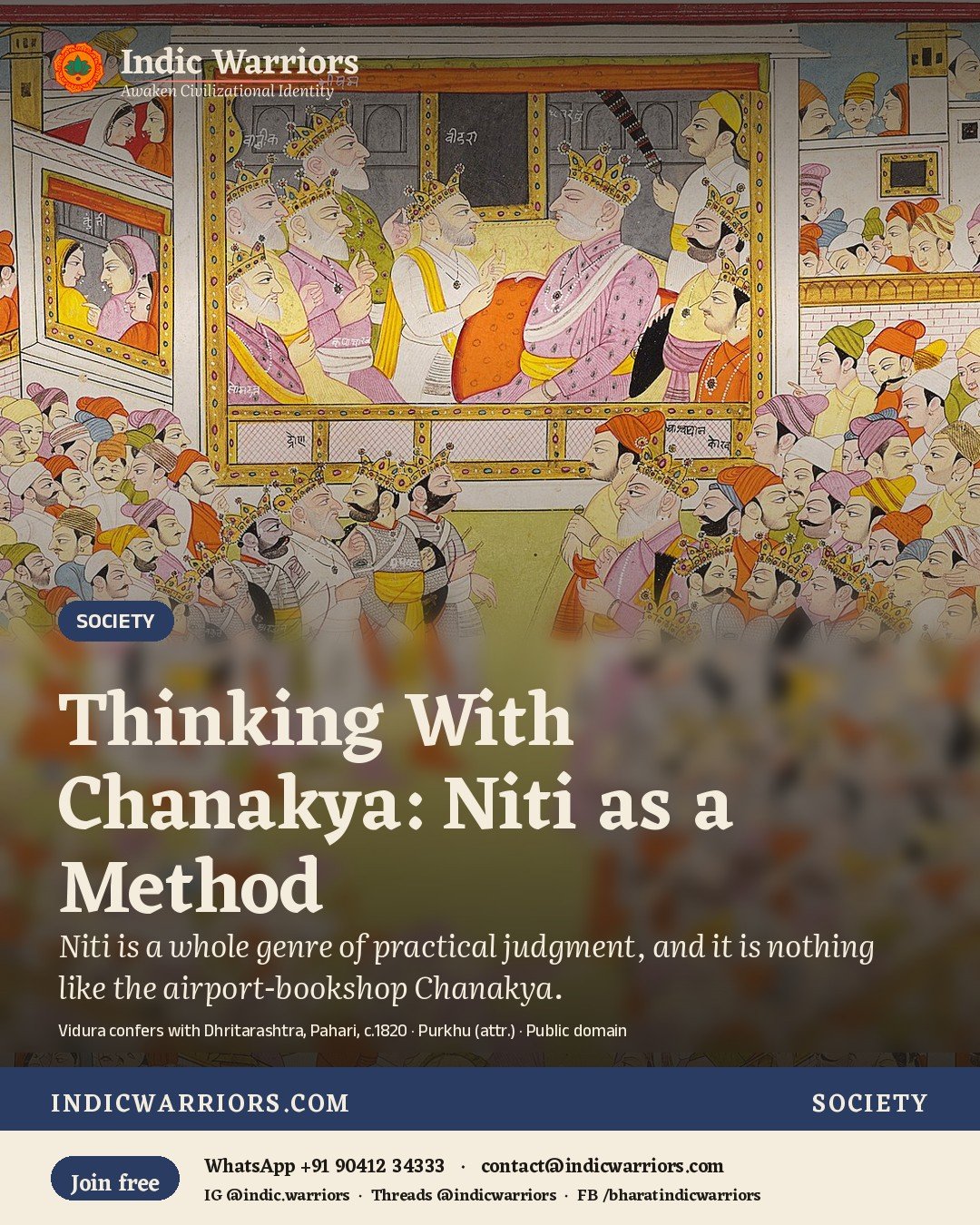
Walk into any Indian airport bookshop and you will find Chanakya on the business shelf, promising the secrets of success, negotiation and getting ahead. It is a strange fate for a body of literature whose actual subject is the administration of a state, and it obscures something more valuable than any of those books deliver: that the Indian tradition developed an entire genre for practical judgment, with its own methods and its own standards, and that the genre is still usable.
Niti is that genre. This is the opening piece on our Niti, Economy and Leadership shelf, which exists because this material had no home anywhere else in our subject map and deserved one.
What niti is, and what it sits next to
The Indian intellectual tradition distinguishes between kinds of guidance. Dharmashastra tells you your obligations: what a person in your position, at your stage of life, owes. The darshanas argue about what is ultimately real and how anyone could know. Niti occupies neither space. It asks a narrower and more immediate question: given the world as it actually is, and people as they actually behave, what is the prudent thing to do?
That is why niti literature reads so differently from either neighbour. It is unsentimental about human motive, comfortable with power, attentive to consequence, and interested in specifics. It assumes people pursue their own interest and treats that as a fact to be worked with rather than a sin to be denounced. What keeps it from becoming mere cunning is that it remains subordinate to dharma: the prudent course is sought within the bounds of obligation, not instead of them.
The literature, in the order it is worth meeting
- The Arthashastra, traditionally attributed to Kautilya, whom the tradition identifies with Chanakya. It is a manual of statecraft and administration: revenue, treasury, land, mines, weights and measures, the duties of officers, the management of adversaries. Its authorship and date are debated by scholars; its character is not. This is a book about running something, written by someone who evidently had.
- Vidura Niti, the counsel Vidura gives within the Mahabharata. Its setting is what makes it powerful: an adviser telling an unwilling king what he does not want to hear, in a story where the reader already knows the advice will be ignored and what the consequence will be.
- The maxim collections — the niti verses and the wider subhashita tradition. Compressed, memorable, endlessly quotable single verses on friendship, wealth, learning, adversity and the character of people worth trusting.
- The story literature, above all the Panchatantra and its descendants, which teach the same judgment through narrative and were explicitly framed as the education of princes. Their onward journey through Persian and Arabic into Europe makes them among the most travelled Indian books in existence.
- The Tamil tradition’s contribution, in a body of ethical verse that treats conduct, household, wealth and governance with the same practical seriousness and is memorised by children to this day.
The method underneath
Read across these and a consistent method appears, which is the reason niti is worth studying as more than a quotation source.
It begins from the situation, not the ideal. Niti asks what is achievable from here, with these people and these resources. This is why it can seem cold to readers accustomed to moral exhortation: it is not telling you what ought to be the case, it is telling you what will happen if you act as though it were.
It treats authority as a role with duties. The king in this literature is not privileged but exposed. His discipline, his schedule, his handling of information and his restraint are all subjects of instruction, because the tradition regards indulgence in a ruler as a public rather than a private failure.
It takes counsel seriously as an institution. A recurring preoccupation is the adviser: how to find one, how to test one, how to hear one, and what happens when the flatterer displaces the honest man. Vidura Niti is the dramatised version of this concern, and the Arthashastra the procedural one.
It studies motive without moralising. People are assumed to act from interest, fear, affection and ambition. Knowing which is operating in a given person is treated as an ordinary competence, the way knowing the weather is.
It teaches by story and by maxim, not by system. Niti has no equivalent of the systematic treatise with its numbered proofs. It works by accumulating cases until the reader’s judgment sharpens, which is a legitimate pedagogy for a subject where the right answer is always situational.
Economy is part of this, not an appendix
The reason our shelf carries economy and leadership alongside niti is that the classical literature never separated them. The Arthashastra’s attention to agriculture, mining, trade routes, currency, weights and the state’s fiscal base is not a digression from statecraft; it is most of it. A treasury is treated as the precondition of every other capacity a polity has, and its management as a moral matter, since the sources of revenue and the fairness of its extraction are discussed as questions of right conduct and not only of yield.
The practical consequence for us is that writing on entrepreneurship, work ethics and institutional leadership belongs on the same shelf as writing on the niti texts. They are the same subject, separated only by two thousand years of vocabulary.
A caution about the Chanakya industry
The popular literature that puts Chanakya’s name on advice about office politics is not doing what it claims. It selects the maxims that sound like modern management, discards the context in which they were constrained by obligation, and presents the result as ancient authority for ordinary ambition. The tradition’s actual position is the one our piece on the four purusharthas sets out: the pursuit of means is legitimate, and it is legitimate because it is governed. Remove the governor and you do not have niti. You have advice.
The honest way to read this material is also the more interesting one: read the primary texts, in translation if necessary, and notice how much of the counsel is about restraint rather than advantage. For the same qualities read through Indian lives rather than through texts, see our review of Bravehearts of Bharat.
Everything on this subject will collect on the Niti, Economy and Leadership shelf.
Credits
Written by the Indic Warriors Editorial team, drawing on the classical niti and arthashastra literature and the story and maxim traditions that carry it. Attributions of authorship follow the tradition’s own, with scholarly debate noted where it exists. No modern teacher’s framework or course structure is reproduced here.
Discussion
Comments are public and carry your name. Your institution is never shown.
Looking for a mentor? Find verified Indic mentors by city. Exploring the institutions? See the colleges guide.