
RT-0004
Ram Mandir, Aurangabad Road: Three Marble Figures Under a Banyan
On Aurangabad Road in Sidhgiribagh, Varanasi, a small temple under an old banyan holds three white marble figures of Ram, Sita and Lakshman, tended by a pandit morning and evening.
 Field notes by Sreya Das
Arya Mahila PG College, Varanasi · Visited 13 November 2025
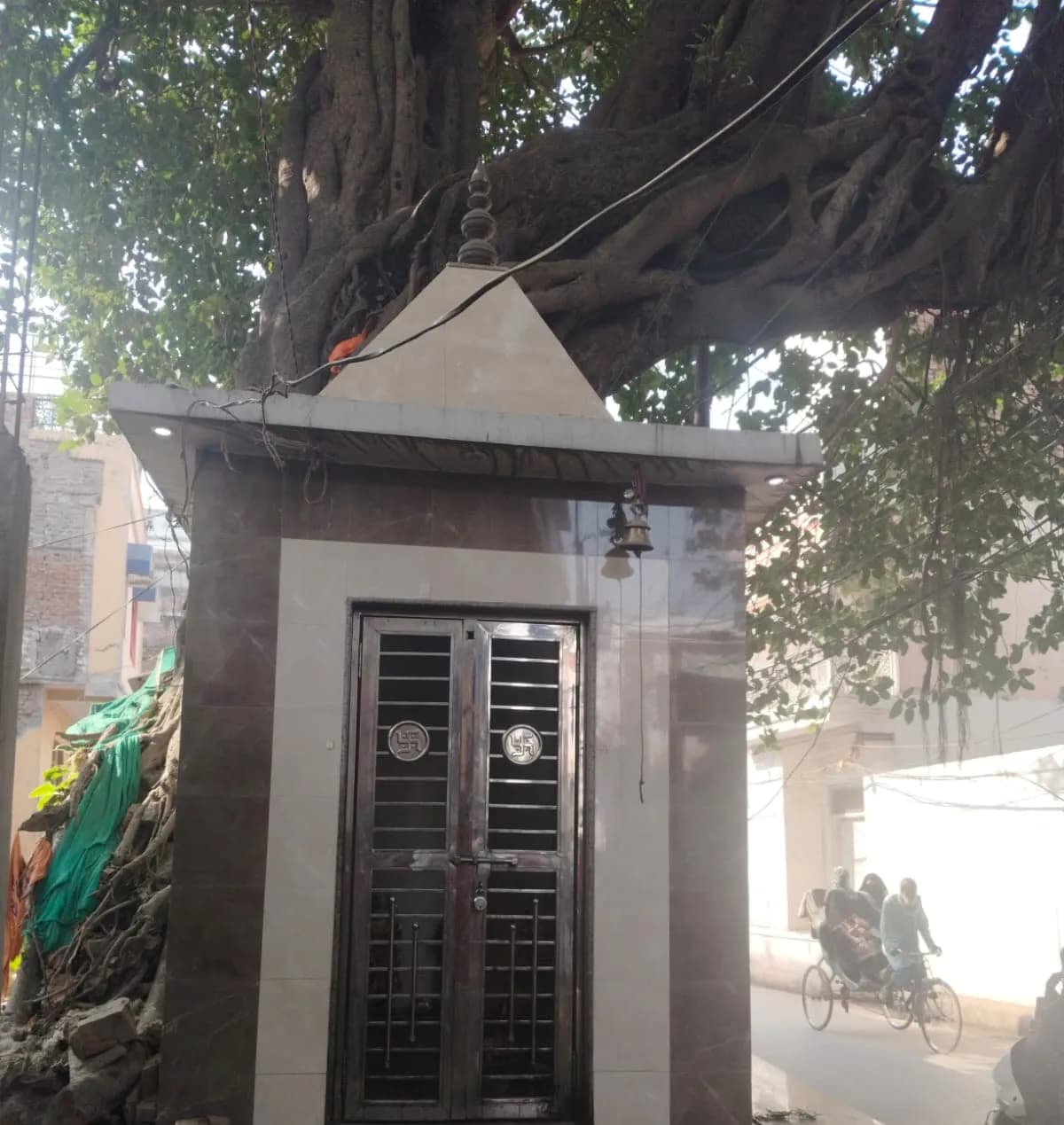
Ram Mandir is a small temple on Aurangabad Road in Sidhgiribagh, Varanasi. It holds white marble images of Ram, his wife Sita and his brother Lakshman, and an old banyan shades it. Sreya Das visited on 13 November 2025.
Finding it
The temple stands along a passageway that links the neighbourhood and its little shops to the main road. The banyan's trunk rises directly behind the roof, and its strong roots hold the ground like an ancient guardian. The tree shades the temple through every storm and in blinding sun. Beneath it the air feels cooler, calm and almost sacred. A cycle rickshaw passes in the lane.
What you see
The building is small and square, faced in white and brown, with a pyramid roof and a steel gate across the front. Despite its size Sreya feels a calm grandeur in the place, the kind of stillness that makes people slow down for a moment.
Inside, on a slightly raised platform, sit three white marble images, each about two feet tall. Ram stands in the centre with a bow in his hand. Sita sits on his left. Lakshman stands on a small rise with a bow, like his elder brother. Each wears a silver crown and red clothes embellished with gold. The pandit polishes the images daily, fresh flower garlands hang on them, and the scent of sandalwood paste lingers in the air.
How it is worshipped
The pandit comes every morning for nitya puja, the daily worship, and every evening for sandhya aarti, the lamp offering at dusk. In the morning he cleans the surroundings, bathes the images and changes their clothes. He offers fresh flowers, fruit and sweets, lights diyas and incense sticks, and recites verses. He finishes by ringing the small bell that hangs outside the sanctum.
Through the day, people stop on their way to work, school and college. They bow briefly and murmur "Jai Shree Ram" under their breath before going on.
What people say
Ram is regarded as the seventh avatar (incarnation) of Vishnu. Born in Ayodhya, he spent fourteen years in forest exile with Sita and Lakshman, and when Ravana, the king of Lanka, carried Sita away, Ram defeated him with the help of Lakshman and Hanuman.
The temple is not as dazzling as the grand Ram temples of Banaras, Sreya says, but it carries a cultural and spiritual weight of its own. For her, the worship of Ram, Sita and Lakshman reflects the heart of North Indian devotional life, where the Ramayana continues to shape moral thinking and social principles, even in a space this small.
The wider picture
From the Indic Warriors Editorial Desk.
Tulsidas composed the Ramcharitmanas, his Awadhi telling of the Ram story, in the sixteenth century, and tradition places much of that work in Kashi. Across the river at Ramnagar, the Ramlila, a staged performance of the story, runs for about a month each year.
UNESCO inscribed Ramlila on its Representative List of the Intangible Cultural Heritage of Humanity in 2008. In the city the story is told in verse and on the stage. At a lane-side temple like this one it is told by three marble figures and a murmured Jai Shree Ram. Our explainer on Ram in Banaras goes further. This entry is part of Roadside Temples, a field series on Indic Warriors.
If you visit
This visit was early on a Thursday afternoon in November. The pandit comes in the morning and again in the evening, and a steel gate protects the images. You can stand outside the gate as people do on their way to work and school, bow briefly and go on.
Field notes by Sreya Das · Edited and expanded by the Indic Warriors Editorial Desk · Published by Indic Warriors