
The Four Purusharthas: What a Human Life Is For
The Indian tradition counts wealth and desire among the legitimate purposes of a human life, and the order it places them in is the entire argument.
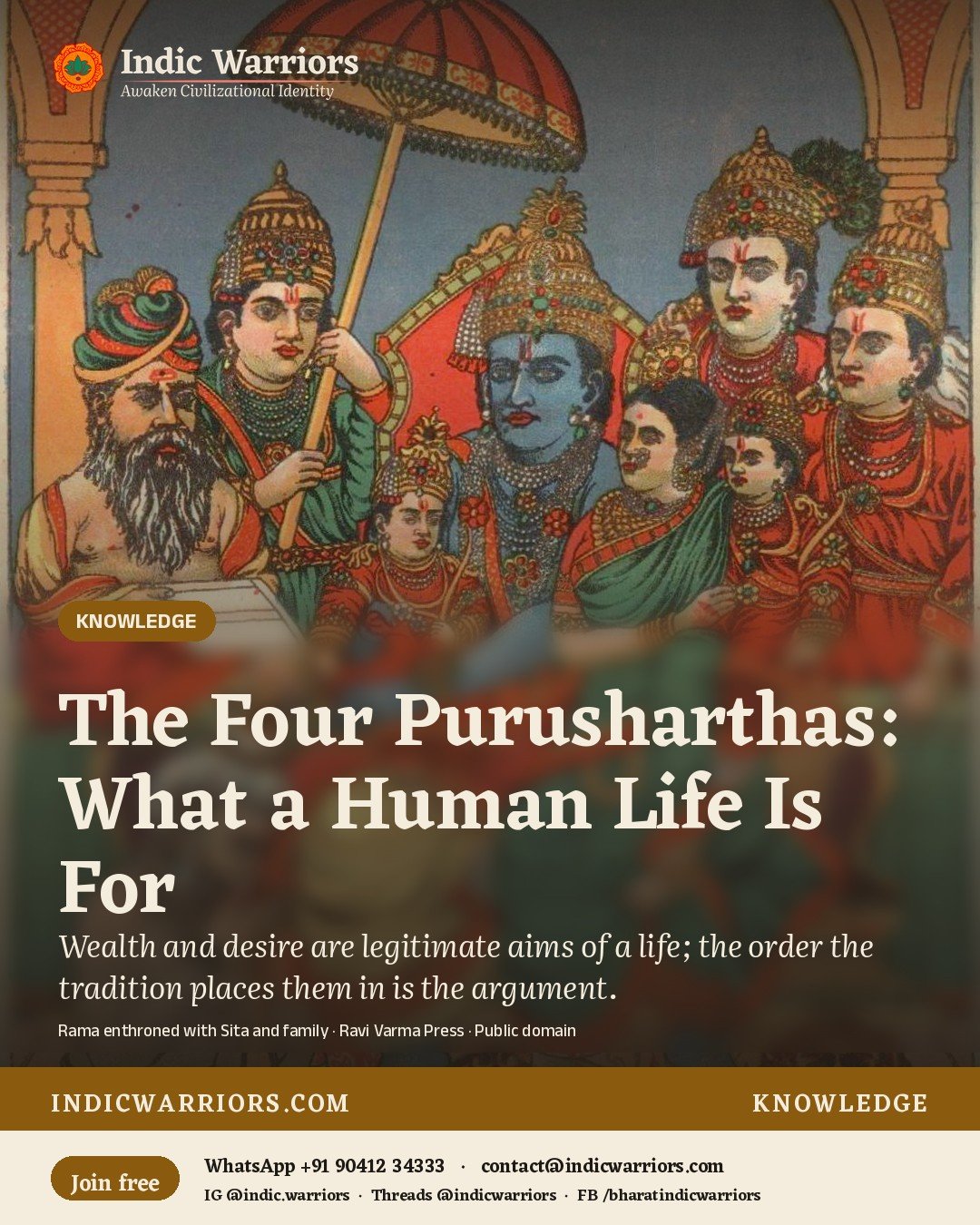
Most ethical systems tell you what is right. The Indian tradition, characteristically, asks a different question first: what is a human life actually for? Its answer is the scheme of the four purusharthas, and the scheme is more interesting than the summaries suggest, because it refuses the choice that most religious ethics forces on people.
The four are dharma, artha, kama and moksha. Right conduct, material means, desire and its fulfilment, and liberation. The word purushartha itself means an object of human pursuit, something worth going after. That framing is deliberate. These are not commandments. They are ends.
The move that makes the scheme unusual
Notice what is on the list. Artha, which covers wealth, security, property, capability and worldly power, is an aim of human life. So is kama, which covers desire in the full sense: pleasure, beauty, love, the enjoyment of the senses, the wanting of things.
This is not a grudging accommodation of human weakness. In a great many traditions, the pursuit of money and the pursuit of pleasure appear only as temptations to be managed. Here they are counted among the purposes. A householder acquiring means and enjoying life is not falling short of the ideal; he is doing one of the things a human being is for.
The consequence is that the tradition never had to develop the peculiar hypocrisy of a society that condemns wealth in its scriptures while pursuing it in its markets. Wealth is legitimate. What is regulated is how it is got and what it is subordinate to.
The ordering is the whole argument
The four aims are not equal and are not meant to be pursued in parallel with equal weight. Dharma is placed over artha and kama as their governor. You may pursue means; you may not pursue means by any means. You may pursue desire; you may not pursue it in violation of your obligations.
The classical literature is unsentimental about this. Artha pursued without dharma is predation. Kama pursued without dharma is appetite. Dharma without either becomes a barren piety that no household can actually run on. The three together are grouped as the trivarga, the worldly triad, and a life that holds all three in the right order is already a successful life by the tradition’s own reckoning.
Moksha then does something different from the other three. It is not a fourth item of the same kind, to be added once the first three are complete. It is the aim that reframes the value of the rest: liberation from the whole cycle of becoming, at which point wealth and desire and even obligation are seen from outside. This is why it is set apart from the trivarga rather than appended to it.
The four aims live in time
The scheme’s practical arm is the arrangement of a lifetime into stages. Study, then householding, then a loosening of worldly involvement, then renunciation for those who go that far. The stages are what stop the four aims from being an impossible simultaneous demand.
A student is not failing at artha by having none. A householder is not failing at moksha by being occupied with a family, a livelihood, and obligations to elders and dependents; that occupation is his dharma for that stage, and the tradition is emphatic that the householder carries the society on his back. What would be a failure is a householder who has never once asked what any of it is for, and arrives at the end of his working life with no answer and no practice for finding one.
Two convenient misreadings
The first misreading turns the tradition into pure world-denial: India as the land of renouncers, the body as an obstacle, the world as illusion to be escaped. That reading has to ignore three of the four aims and most of the literature on kingship, trade, marriage, food, aesthetics and household duty.
The second misreading, currently more fashionable, treats the scheme as an early productivity framework, a balanced-life diagram with liberation as self-actualisation on top. That reading keeps artha and kama and quietly discards the thing that ordered them. What is left is not the purusharthas. It is ambition with Sanskrit labels.
The scheme only works as a hierarchy. Remove dharma from the middle and it becomes a list of appetites; remove moksha from the end and it becomes a well-managed life with no horizon.
What it asks of a reader now
The useful exercise is not to rank the four in the abstract but to audit them. Which of the four is actually receiving your time this year? Almost everyone discovers that artha has quietly annexed the others, and that kama is being pursued as compensation for it. The tradition’s diagnosis of that condition is neither guilt nor permission. It is order: obligations first, then means, then enjoyment, with the question of what all of it is for kept alive rather than deferred to old age.
The metaphysics underneath this scheme, the account of what a person is such that liberation is even coherent, is taken up in our notes on Purusha, Prakriti and karmic flow. For the wider map of schools that argue about it, see our lecture on the Indian philosophical traditions.
Credits
Written by the Indic Warriors Editorial team. This piece draws on the classical dharmashastra and darshana literature in which the purusharthas and the stages of life are set out, and on the standard vocabulary the tradition uses for them. It reproduces no individual teacher’s syllabus or interpretive system.
Discussion
Comments are public and carry your name. Your institution is never shown.
More in Dharma & Philosophy
Looking for a mentor? Find verified Indic mentors by city. Exploring the institutions? See the colleges guide.